





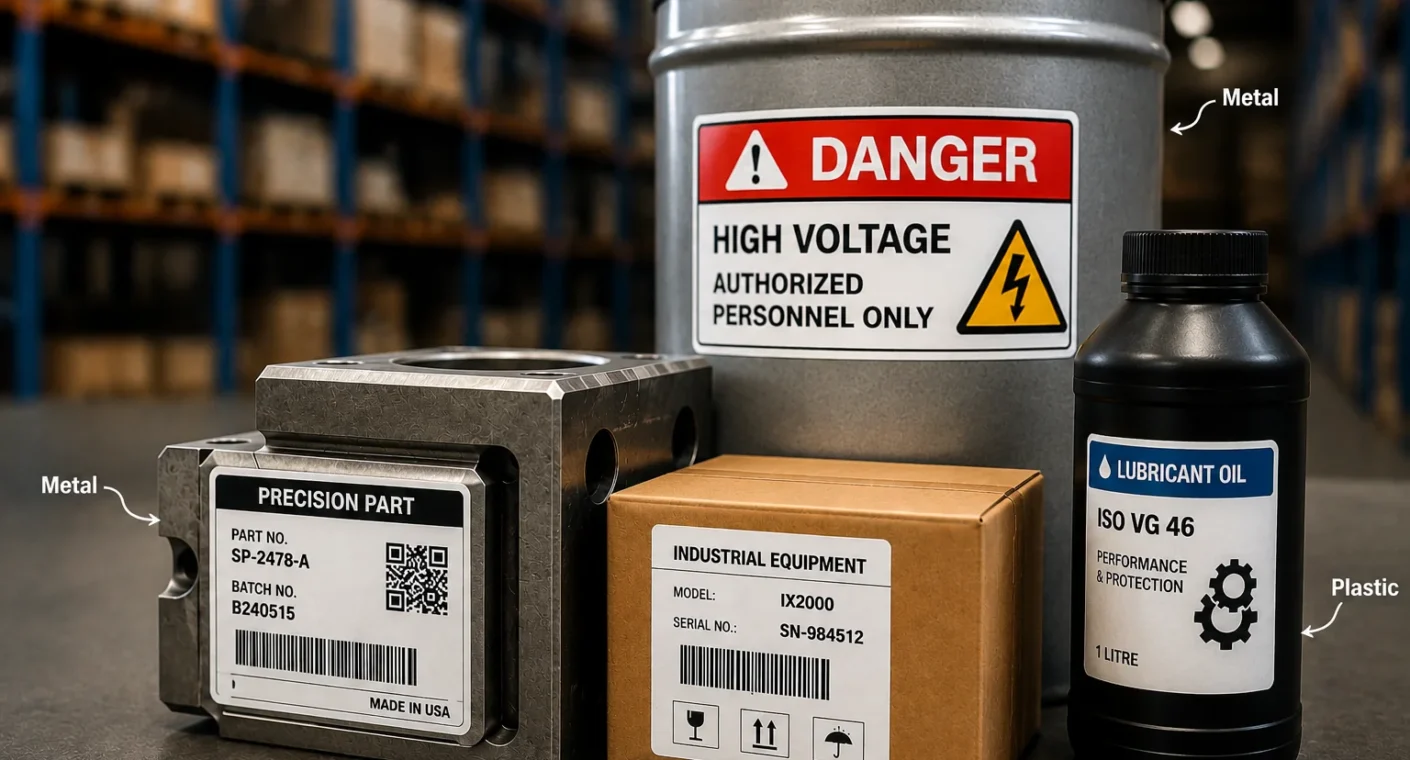
Industrial labels are often treated as a small part of packaging. In reality, they directly affect inventory management, shipment accuracy, compliance, and product tracking.
A label failure during transportation can create operational problems that cost far more than the label itself.
Many businesses importing industrial labels focus only on pricing or printing quality. However, global supply chains demand much more.
Labels must survive storage conditions, long-distance shipping, moisture exposure, rough handling, and automated barcode scanning systems.
If you are planning to buy customised industrial labels for your business, here are five important factors you should evaluate before finalising a supplier.
1. The Label Material Must Match Your Actual Working Conditions
One of the most common mistakes buyers make is selecting label materials based only on appearance or cost. Businesses working across multiple sectors often require different labeling solutions depending on their operating conditions, which is why many companies explore industrial labeling solutions for different industries before finalising materials.
A label that works perfectly in an office environment may completely fail inside a warehouse, manufacturing unit, export container, or chemical storage area. This is why businesses should carefully evaluate material quality when buying customised industrial labels for long-term industrial use.
For example, many export businesses face label peeling issues during sea transportation. Containers often experience high humidity and temperature fluctuations. If the material is not designed for such conditions, the label may wrinkle, fade, or detach before the shipment reaches the customer.
Similarly, labels used on chemical drums or industrial machinery need stronger durability compared to labels used for retail cartons.
A reliable industrial label supplier should first understand where and how the label will be used. The material selection should depend on the actual environment rather than generic recommendations while selecting customised industrial labels for business operations.
Businesses handling industrial exports usually prefer suppliers with experience across multiple sectors because they better understand how different surfaces, storage conditions, and transportation environments affect label performance.
It is also important to work with manufacturers that follow structured production and quality processes. Businesses can learn more about this through Labelton’s industrial label manufacturing process.
2. Adhesive Quality Matters More Than Most Buyers Expect
Many businesses realise the importance of adhesive quality only after facing shipment problems.
A label may look perfectly printed during dispatch. But if the adhesive fails midway through transportation, barcode scanning becomes difficult and package identification may stop completely.
This becomes a serious issue in international logistics where automated systems rely heavily on barcode readability. Businesses dealing with exports often prefer working with an experienced industrial label supplier for global businesses because international shipping environments demand stronger adhesive performance and long-term durability.
For instance, some businesses importing industrial labels for export cartons face problems when labels start lifting from corners after exposure to moisture inside containers. In some cases, warehouse scanners fail to read partially detached labels, which creates delays in inventory processing. Global barcode and supply chain standards set by GS1 barcode guidelines also highlight the importance of barcode readability and label performance during logistics operations.
Different industries require different adhesive strengths. Labels used on metal surfaces behave differently from labels used on plastic drums, corrugated boxes, or cold-storage packaging. This is why adhesive selection becomes a critical factor when buying customised industrial labels for export and industrial applications.
This is why experienced manufacturers usually recommend adhesive types after understanding:
- Surface texture
- Storage temperature
- Moisture exposure
- Transportation conditions
- Product handling frequency
Instead of selecting low-cost generic adhesive labels, businesses should focus on long-term operational reliability.
3. Barcode Readability Should Support Global Logistics Systems
Today, most warehouses and shipping operations depend on automated barcode scanning. Even a minor print issue can interrupt the supply chain, which is why barcode performance becomes an important factor when buying customised industrial labels.
A barcode that becomes unreadable during transportation can lead to parcel rejection, manual verification delays, inventory mismatch, or failed tracking updates. This situation is more common than many businesses think, especially in export-focused industries where labels pass through multiple warehouses and scanning checkpoints.
For example, labels printed with low-quality ink or improper thermal transfer settings may initially scan correctly. But after friction during transportation or exposure to moisture, the barcode may start smudging. Once scanners fail to read the code, warehouse teams often move shipments into manual processing queues, which slows down operations and affects supply chain efficiency.
This becomes especially critical for industries handling bulk exports, pharmaceuticals, chemicals, automotive components, or industrial equipment. Businesses facing such logistics issues often look for practical ways to reduce shipment risks and improve barcode readability during exports. You can explore more about How to Avoid Parcel Rejections in International Shipping.
Businesses should always verify whether the supplier can maintain:
- High print clarity
- Consistent barcode quality
- Smudge resistance
- Thermal transfer compatibility
- Long-term readability
An experienced supplier generally performs print quality inspections before dispatch because barcode failure affects the entire logistics chain, not just the packaging appearance.
4. Manufacturing Consistency Is Critical for Bulk Orders
Many buyers focus heavily on the sample quality but ignore production consistency.
A supplier may deliver an excellent first batch but fail to maintain the same standards during larger repeat orders. This creates problems like color inconsistency, uneven adhesive performance, size variation, or printing defects.
In industrial operations, even small inconsistencies create operational inefficiencies.
Imagine a warehouse using automated barcode systems where one batch scans perfectly while another batch causes repeated scanning failures. The issue may look small initially, but over thousands of products, it increases handling time and operational costs.
Businesses importing customised industrial labels should evaluate whether the supplier has proper manufacturing controls in place. Companies managing large-scale procurement often prefer suppliers with proven experience in handling bulk production and export operations. You can understand more about how bulk industrial label orders are managed to see how production consistency affects long-term operational reliability.
This includes checking:
- Production capability
- Quality inspection process
- Batch consistency
- Export handling experience
- Delivery reliability
Suppliers experienced in bulk industrial production usually follow structured quality checks because large-volume buyers expect stable performance across every shipment. Businesses planning long-term partnerships can also talk to an industrial label expert for application-specific guidance and production support.
5. Global Compliance Requirements Should Never Be Overlooked
Industrial labels are not just stickers. In many industries, they carry legally important information related to safety, traceability, product identification, and handling instructions.
If labels fail to meet required standards, businesses may face shipment delays, compliance concerns, or operational risks.
For example, chemical exporters often require labels that remain readable even after exposure to industrial environments. Similarly, export packaging may need labels that maintain barcode clarity throughout long transit cycles.
Businesses supplying international markets should always confirm whether the supplier understands global operational requirements.
A reliable industrial label manufacturer usually considers:
- Durability standards
- Export packaging conditions
- Barcode requirements
- Industry-specific applications
- Long-term readability expectations
Working with suppliers experienced in industrial and export-focused manufacturing helps businesses reduce avoidable risks in global operations.
Buying customised industrial labels is not only about getting the design printed. The real goal is long-term operational reliability.
A durable label helps businesses improve tracking accuracy, maintain compliance, reduce shipment errors, and support smooth logistics operations. Businesses supplying domestic and international markets often prefer working with experienced manufacturers that understand industrial applications, export requirements, and large-scale production standards. You can explore more about custom industrial labels for business packaging to understand how industrial labeling solutions support operational efficiency across different sectors.
Before finalising any industrial label supplier, businesses should carefully evaluate material quality, adhesive strength, barcode readability, manufacturing consistency, and compliance understanding.
Choosing the right labelling partner can significantly reduce operational disruptions while improving supply chain efficiency across domestic and international markets.