




Every product label carries important information. It helps identify products, supports traceability, improves inventory management, and ensures regulatory compliance.
Even a small printing error can create operational delays, scanning failures, customer complaints, or product recalls.As production volumes continue to grow, manufacturers need faster and more reliable ways to maintain label accuracy.
Manual inspection still plays a role, but it becomes difficult to detect every defect during high-speed production. This is where artificial intelligence creates a measurable difference.
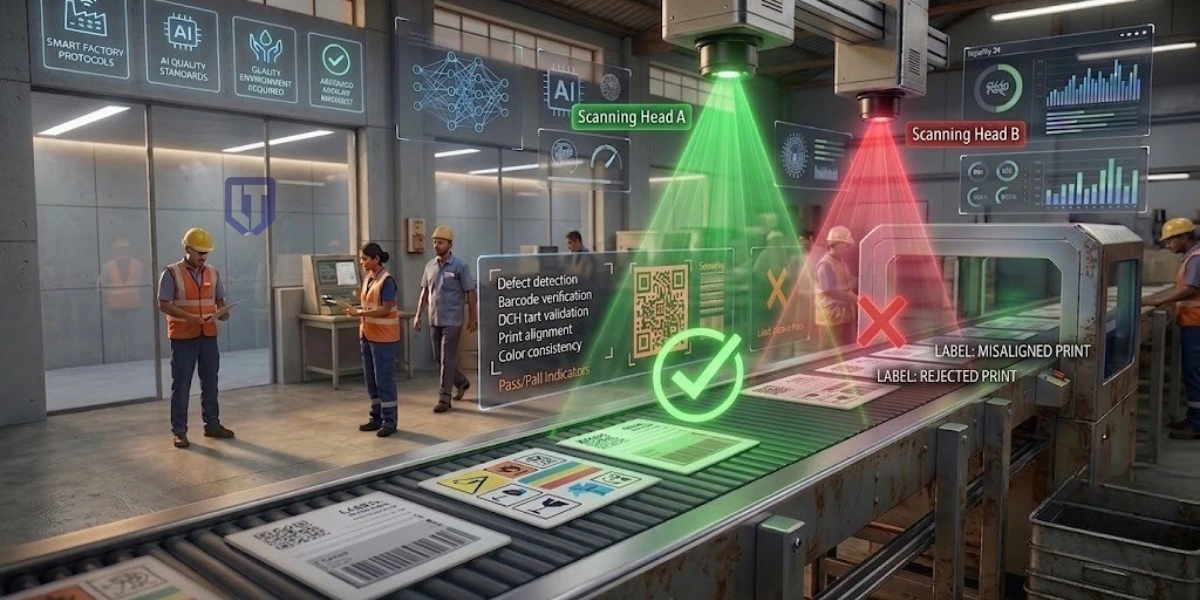
AI-powered systems improve Label Inspection by detecting defects in real time, reducing human error, and maintaining consistent quality across production batches. Instead of replacing quality teams, AI helps them make faster and more informed decisions.
In this blog, we discuss how AI is transforming Label Inspection, why it matters for modern manufacturers, and how it strengthens overall quality control.
Why Label Inspection Matters More Than Ever
A product label is more than a printed sticker. It communicates essential product information and supports every stage of the supply chain.
Poor Label Inspection can lead to:
- Incorrect barcode printing
- Missing product information
- Poor print quality
- Color inconsistencies
- Wrong variable data
- Compliance issues
- Shipment delays
For industries such as pharmaceuticals, food, chemicals, logistics, and manufacturing, these mistakes create financial losses and damage customer trust.
Before placing a large production order, reviewing how to evaluate industrial label quality before bulk order helps businesses establish clear quality expectations and avoid preventable issues later in production.
How AI Changes Traditional Label Inspection
Traditional Label Inspection depends heavily on manual observation or basic vision systems. Although experienced inspectors identify many defects, fatigue and production speed make it difficult to maintain consistent accuracy.
Artificial intelligence changes this process by learning from thousands of label images.
Instead of checking only predefined rules, AI analyzes complete label patterns. It identifies defects that may be difficult for the human eye to notice.
Modern AI systems continuously inspect:
- Print clarity
- Barcode quality
- QR code readability
- Text alignment
- Color consistency
- Missing labels
- Incorrect variable data
- Damaged label surfaces
This allows manufacturers to identify problems before products leave the production line.
Real-Time Defect Detection Improves Quality Control
One of the biggest advantages of AI is real-time monitoring.
Instead of discovering defects during final quality checks, AI detects them while labels move through production.
This approach offers several benefits:
- Immediate defect alerts
- Faster corrective actions
- Lower material waste
- Reduced production downtime
- Better production consistency
Continuous Label Inspection helps manufacturers prevent defective products from reaching packaging or shipping operations.
AI Improves Barcode Verification
Barcode quality directly affects warehouse operations, inventory management, and global shipping.
Even minor printing issues may prevent scanners from reading barcodes correctly.
AI systems analyze barcode quality beyond simple readability. They evaluate print contrast, edge definition, spacing, and symbol accuracy.
This helps manufacturers reduce scanning failures throughout the supply chain.
Many businesses also reduce operational risks by addressing the common causes of barcode scanning issues in global shipping and improving overall print quality.
Manufacturers commonly follow internationally recognized barcode specifications published by GS1 Standards to maintain consistent barcode performance across global supply chains.
AI Supports Consistent Print Quality
Maintaining consistent print quality becomes challenging during long production runs.
Changes in printer settings, ribbon quality, temperature, or material condition may gradually reduce print performance.
AI continuously compares every printed label against quality standards.
It quickly identifies:
- Faded printing
- Ink spread
- Missing characters
- Smudged text
- Registration errors
This continuous Label Inspection helps maintain consistent product presentation while reducing quality variations across production batches.
Environmental Conditions Also Affect Label Quality
Artificial intelligence detects printing defects, but manufacturers must also choose suitable label materials.
Environmental conditions such as moisture, heat, UV exposure, dust, and chemicals directly affect label performance.
If materials are unsuitable, even perfect printing may fail during transportation or storage.
Selecting label materials based on how weather conditions affect adhesive labels during transportation and storage helps improve long-term durability in demanding environments.
Combining durable materials with AI-powered Label Inspection creates stronger overall quality control.
AI Helps Reduce Human Error
Manual inspections remain valuable because experienced operators understand production challenges.
However, repetitive inspection tasks naturally increase the chances of missed defects.
AI reduces this risk by inspecting every label with the same level of accuracy.
It never becomes tired during continuous production.
Instead of replacing inspectors, AI allows quality teams to focus on:
- Process improvements
- Root cause analysis
- Equipment optimization
- Quality planning
This creates a better balance between automation and human expertise.
Better Label Inspection Improves Supply Chain Performance
Accurate labels support every stage of logistics.
A single labeling error may create inventory confusion, delayed shipments, customs issues, or customer complaints.
Reliable Label Inspection helps businesses achieve:
- Better inventory accuracy
- Faster warehouse operations
- Improved product traceability
- Higher customer confidence
- Fewer shipment rejections
Many exporters also strengthen shipping reliability by identifying the common reasons behind parcel rejections in international shipping, where labeling accuracy often plays a critical role.
AI Helps Manufacturers Make Smarter Labeling Decisions
Artificial intelligence also provides valuable production insights.
Instead of only identifying defects, AI collects quality data over time.
Manufacturers can analyze trends such as:
- Frequently occurring defects
- Machine performance
- Print consistency
- Material performance
- Production efficiency
These insights help improve future production planning and reduce recurring quality issues.
Businesses preparing for new labeling requirements often benefit from reviewing the key factors involved in buying customized industrial labels, helping them select solutions that match their operational needs.
The Future of AI in Label Inspection
Artificial intelligence is reshaping Label Inspection by making quality control faster, more accurate, and more consistent. While AI helps detect defects early and improve production efficiency, reliable label materials, proper printer settings, and standardized quality practices remain essential for achieving consistent results.
Building a Smarter Quality Process
For high-volume label production, maintaining quality at every stage helps improve product reliability and production efficiency. Using the right materials, optimized printing processes, and consistent inspection standards supports long-term operational performance.
Many manufacturers also review how bulk industrial label orders are managed efficiently to gain practical insights into large-scale production and quality control processes.
When you need industrial labeling solutions tailored to your application, The Labelton, a 30+ years old label manufacturing brand, supports businesses with dependable labeling solutions designed for consistent quality and reliable performance across a wide range of industrial applications.